My Kids Started Acting Like Me — and I Had to Sit With How Uncomfortable That Was
It happened on a Thursday afternoon, which feels too ordinary for how much it changed me.
My daughter — she's nine — was trying to finish a puzzle while her little brother kept nudging the table. She turned to him with this sharp, impatient exhale and said, "Can you just stop? I'm trying to concentrate." Then she went quiet and rigid, jaw tight, eyes fixed on the puzzle like she could will the chaos away by ignoring it.
And I thought: I do that. That's me. That is exactly what I do.
I didn't say anything in the moment. I just stood in the kitchen doorway holding a dish towel, feeling something cold move through my chest.
The Realization Nobody Warns You About
We spend a lot of time as parents talking about what we want to give our kids. The values, the confidence, the work ethic. We frame it in terms of legacy — what good things we want to pass down.
What we talk about a lot less is what gets passed down whether we mean for it to or not.
I grew up in a household where stress was managed through silence and control. If something felt like too much, you got quiet. You pushed through. You kept your face calm and your feelings somewhere no one could see them. My parents weren't cruel — they were doing what they knew. But those patterns got wired into me so early that for years I didn't even recognize them as patterns. I just thought that's how you handled hard things.
And now here was my daughter, nine years old, doing the exact same thing with a puzzle.
I'd been passing it down without even knowing I was doing it.
The Part That's Hard to Admit
There's a specific kind of shame that comes with this realization. It's not the loud, dramatic kind. It's quieter. It sits in your stomach and asks you uncomfortable questions.
If she's already doing this at nine, what does that look like at thirty? How long has she been watching me and filing it away? What else have I handed her that I haven't noticed yet?
I started paying attention differently after that Thursday. Not obsessively — I wasn't tracking every behavior with a clipboard — but I was watching with new eyes. And what I saw was both humbling and, honestly, kind of beautiful in a complicated way.
My son, who's six, has my habit of needing to narrate everything he's feeling out loud. My daughter has my perfectionism, my sensitivity to noise, my tendency to go inward when things feel like too much. They also have my curiosity, my love of a good story, my need to make people laugh when the air gets heavy.
The wounds and the gifts. They were getting all of it.
What Breaking a Cycle Actually Looks Like
Here's what I want to push back on: the idea that recognizing this means you need to completely overhaul who you are. I've seen that advice. Heal yourself before you parent. Break every generational cycle. It sounds clean and empowering, but in practice it can become its own form of anxiety — one more thing to fail at.
I don't think the goal is to become a different person. I think the goal is to become a more visible person to your kids.
After that Thursday, I started naming things out loud. When I felt overwhelmed and wanted to go quiet, I'd say it instead. "Hey, I'm feeling a little stressed right now — I'm going to take five minutes and then I'll be better company." When I caught myself being short with someone, I'd come back and say, "That came out wrong. I was frustrated, but that wasn't fair."
Small things. Unglamorous things. But what they do is show your kids that the feeling and the behavior aren't the same thing. That you can feel overwhelmed without becoming the overwhelm. That you can notice a pattern and make a different choice — not every time, not perfectly, but sometimes. Enough.
The Conversation I Had With My Daughter
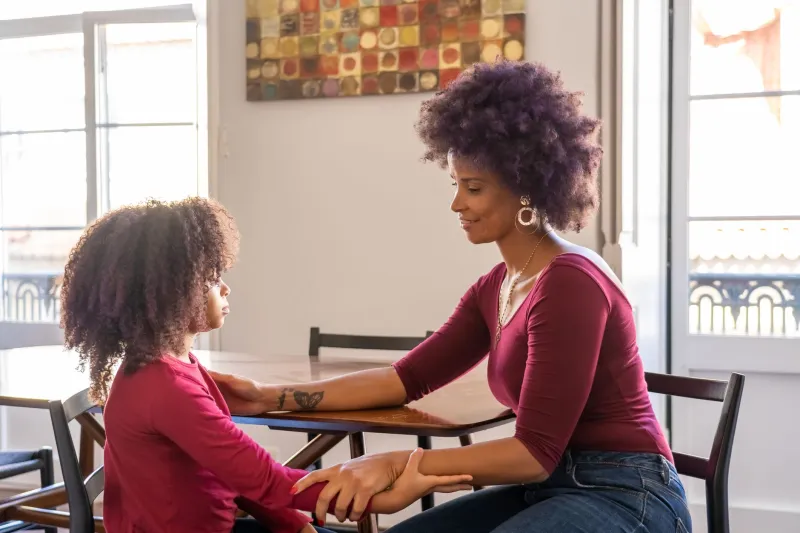
About two weeks after the puzzle incident, I sat down with my daughter and told her, in plain language, that I noticed she goes quiet when things feel like a lot. I told her I do the same thing. I told her it's not wrong, but that I've learned it can sometimes make people around you feel shut out, and I was still figuring out better ways to handle big feelings.
She looked at me for a long moment and said, "So we're both working on it?"
I said yes. We were both working on it.
Something shifted in her face — not relief exactly, but recognition. Like she'd been handed permission to be in process, the same way she'd been watching me be in process without realizing that's what it was.
You're Not Ruining Them
If you've had a moment like my Thursday — if you've caught a glimpse of yourself in your kid and felt that cold, uncomfortable feeling — I want to say this as clearly as I can: you are not ruining your children by being human.
The fact that you noticed? That already puts you somewhere different than where a lot of us started.
You don't have to be a perfectly healed, fully self-actualized parent to raise kids who do better than you in the places you struggled. You just have to be honest with them — and with yourself — about what you're still figuring out.
That Thursday changed something in our house. Not because I became a different mom, but because I stopped pretending I had it all sorted. My kids don't need a parent without wounds. They need a parent who doesn't pass the wounds along by pretending they aren't there.
We're all still working on it. And it turns out, that's enough.