My Kid Started Checking On Me — and I Didn't Know Whether to Feel Grateful or Ashamed
It happened on a Tuesday, which feels right somehow. Nothing life-altering ever seems to happen on a Saturday when you're prepared for it.
I'd had a brutal day. The kind where everything that could go sideways did, and by the time I walked through the front door I was running on fumes and bad coffee. I dropped my bag, kicked off my shoes, and before I could even exhale, my daughter Maya looked up from the kitchen counter and said, "Hey. You okay? You look like today was a lot."
She's twelve.
I almost laughed it off. Almost said I'm fine, honey the way I always do, the way that ends conversations before they start. But something in her face stopped me. She wasn't asking because she needed something. She was asking because she'd noticed me. Really noticed me.
And I didn't know what to do with that.
The Shift You Don't See Until It's Already Happened
I've been thinking about that moment for weeks now. Because it wasn't a one-time thing. Looking back, I can see the pattern building over the past year or so — Maya quietly becoming the emotional temperature-checker of our household. She's the one who notices when her little brother is on the verge of a meltdown before I do. She's the one who'll say, "Mom, I think you need to eat something" after I've been on back-to-back calls all afternoon.
She started doing this so gradually that I never clocked it as a thing. It just felt like her growing up, becoming more aware, more empathetic. And those are good things. They are. But there's another layer underneath that I had to sit with, and it wasn't entirely comfortable.
When did she start carrying me?
The Guilt That Came Out of Nowhere
Here's the part nobody really talks about: the guilt that shows up when your child loves you in a way you didn't ask for and maybe didn't deserve.
I didn't set out to need my daughter's emotional support. I wasn't consciously leaning on her. But somewhere in the chaos of single-tasking a thousand things at once — work, school pickups, grocery runs, permission slips, all of it — I'd been visibly fraying. And she'd been watching. And she'd responded the way she always responds to the people she loves: by showing up.
The shame spiral started slowly. Am I burdening her? Have I been too transparent about my stress? Is she going to grow up thinking she's responsible for keeping me okay?
I went down that road hard for a few days. Replaying conversations, second-guessing moments, wondering if I'd somehow failed at the basic job of being the adult in the room.
What I Eventually Figured Out (With Some Help)
I talked to a friend about it — another mom who's been doing this longer than me — and she said something that reframed everything. She said, "You didn't make her into a caretaker. You raised someone with enough emotional intelligence to recognize when the people she loves are struggling. Those are not the same thing."
I had to let that land.
There's a difference between a child who feels responsible for a parent's emotional state and a child who has learned to express care and notice others. One is a burden. The other is a gift. And the line between them is something worth paying attention to — but it's not always as blurry as the guilt spiral makes it seem.
Maya wasn't anxious when she asked about my day. She wasn't scanning my face for signs of danger. She was just... kind. Curious. Present. Because that's who she is.
Letting Your Kids Love You Differently Than You Expected
What I've been sitting with since then is how much of parenting is about controlling the narrative. We want to be the strong ones, the ones with answers, the ones who hold everything together. Letting our kids see us as full human beings — people who have hard days and complicated feelings — can feel like exposure. Like we're taking something from them.
But I think we're actually giving them something.
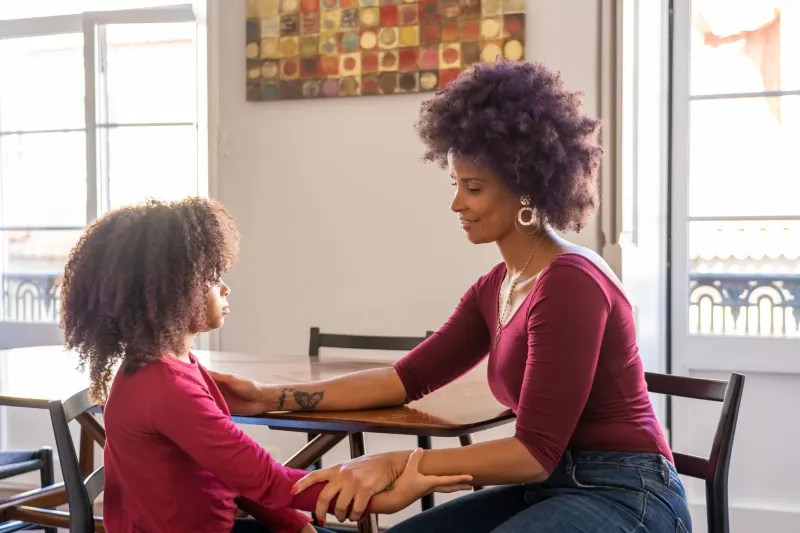
When Maya checks in on me, and I actually answer honestly — not dramatically, not in a way that puts my weight on her small shoulders, but honestly — she learns that emotions aren't emergencies. That you can have a hard day and still be okay. That the people you love will sometimes need you to show up, and that's not a crisis. It's just love.
I've started being more intentional about how I receive her care. I say thank you. I answer her real question with a real answer. And then I check in on her, because reciprocity matters, and because she deserves to be seen too.
What I Want Her to Take From This
I'm not trying to raise a child who thinks it's her job to manage my feelings. But I also don't want to raise a child who's been taught that emotions are something to hide, that needing people is weakness, that the adults in her life are untouchable.
I want her to know that she matters enough to me that her noticing matters. That when she asks if I'm okay, I take it seriously. That her empathy is one of the most extraordinary things about her, and I'm not going to shut it down just because it makes me feel a little vulnerable.
She's not parenting me. She's loving me. And I'm learning, slowly, to let her.
That Tuesday conversation? I told her the truth. I said it had been a hard day, that I was tired, and that having her notice made it better. She nodded, went back to her homework, and said, "You should probably eat something."
She's not wrong. She's never wrong about that.