My Mom Took Her Stories to the Grave — I'm Giving Mine to My Kids While I'm Still Here

The Questions I Never Got to Ask
My mother was fifty-three when she died. I was in my late twenties, and I thought I had more time. We all think we have more time.
In the years since, I've accumulated a list — not a written one, but a mental one — of questions I never asked her. What was she afraid of when she was my age? Did she ever feel like she was failing as a mother? What did she dream about before life narrowed her options down? What hurt her the most?
I don't know the answers to any of it. She was a private person, raised in a family where you kept your difficulties to yourself and showed the world your composed face. She was warm and present in the ways that mattered. But her inner life, her story before she became my mother — that stayed sealed.
I think about it more now that I have kids of my own. And what I think about most is this: I don't want them to have that list.
What We Lose When Parents Don't Tell Their Stories
There's a version of parenting that treats the parent's past as irrelevant. Your job is to be stable and forward-facing. Your struggles are yours to process privately. You protect your kids from the messiness of your own history.
I understand that instinct. I've felt it. There's a real desire to be the solid ground for your children, not another complicated thing they have to navigate.
But I've come to believe that this kind of protection has a cost.
When children only ever see the composed, capable version of their parent, they have no model for what it looks like to struggle and survive. They see the outcome — the adult who has it together — but not the process. And when they inevitably hit their own hard moments, they have no reference point. They think they're the only one who has ever felt this lost, this scared, this confused.
Shame grows in that gap. The gap between who they think they're supposed to be and who they actually are. And if their parents have never shown them the gap exists for everyone, it fills with the terrifying conclusion that something must be uniquely wrong with them.
Telling your story isn't weakness. It's a form of inheritance.
What I've Started Doing
I'm not a natural oversharer. I'm not the mom who processes everything out loud. But over the past few years, I've made a deliberate effort to let my kids see more of my story — not to burden them with it, but to give them something they can use.
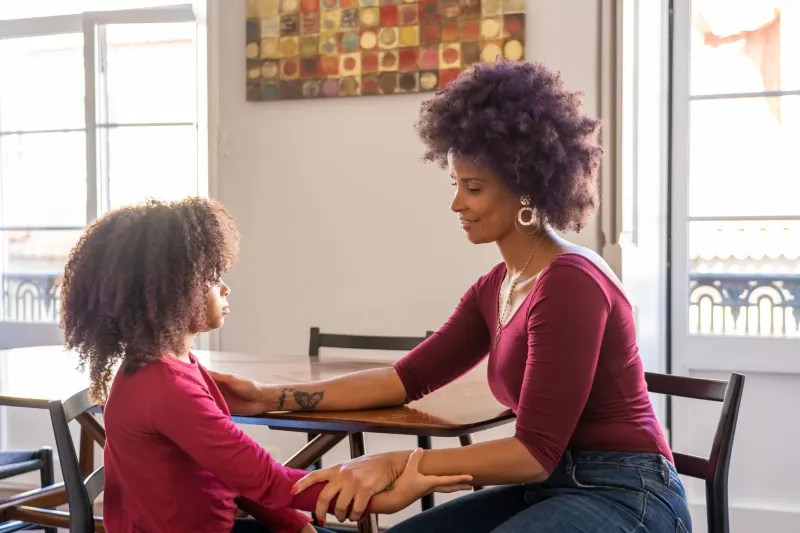
It started small. I mentioned once, offhandedly, that I had a terrible time making friends when I was in middle school. My daughter stopped what she was doing and looked at me like I'd just told her something classified. You did? Yes. I did. It was genuinely awful for a while.
What followed was one of the best conversations we've had. She had questions. Real ones. And then she told me about something she'd been sitting on for weeks — a friendship that was falling apart — that she'd been too embarrassed to bring up because she thought she was the only one who struggled with that stuff.
She thought I'd always been fine. I'd never told her otherwise.
The Stories That Matter Most
I'm not suggesting parents turn their kids into therapists or confessional booths. There's a version of parental oversharing that's genuinely not appropriate — trauma-dumping, processing adult problems through children, asking them to carry things they shouldn't have to carry.
That's not what I mean.
What I mean is this: the stories that changed you are the ones worth telling. The time you failed and kept going anyway. The thing you were terrified of and did anyway. The dream you had that didn't work out, and what you found on the other side of that.
For me, that's included:
- Telling my kids about the job I got fired from in my twenties, and how humiliated I felt, and what I figured out afterward.
- Talking about a friendship that ended badly and how I handled it wrong and what I'd do differently.
- Sharing that there was a period of my life when I wasn't sure what I believed about anything — faith, my future, my own worth — and how I found my footing again.
None of these conversations were dramatic. They came up naturally, usually connected to something my kids were already going through. But each time, I watched something shift in them. A kind of relief. Like they'd been given permission to be imperfect too.
The Person Before the Parent
One thing I've been intentional about is helping my kids understand that I existed before I was their mother. That I had a life with a plot — a beginning, a messy middle, chapters I'd rather forget and chapters I'm proud of.
This sounds obvious, but kids don't naturally construct that picture. To them, you materialized into existence as their parent. You've always been the adult. You've always been in charge.
When I show them the person I was before — younger, less sure of herself, making choices that didn't always work out — something humanizes between us. I stop being just a function and start being a person. And they respond to that. They ask follow-up questions. They share things back.
I've started keeping some of this in writing, too. Nothing formal. Just notes on my phone about things I want them to know someday — stories that might not come up naturally, feelings I've had that I want them to be able to find if they ever need them.
My mother never did that. I understand why. But I've decided to do it differently.
What I Want Them to Carry
I don't need my kids to know everything about me. Some things are mine, and that's okay.
But I want them to know enough to feel less alone in their own hard moments. I want them to know that their mother was afraid sometimes, and confused sometimes, and got things wrong more than she'd like to admit. And that none of it was the end of the story.
That's the inheritance I'm trying to leave while I'm still here to give it.